
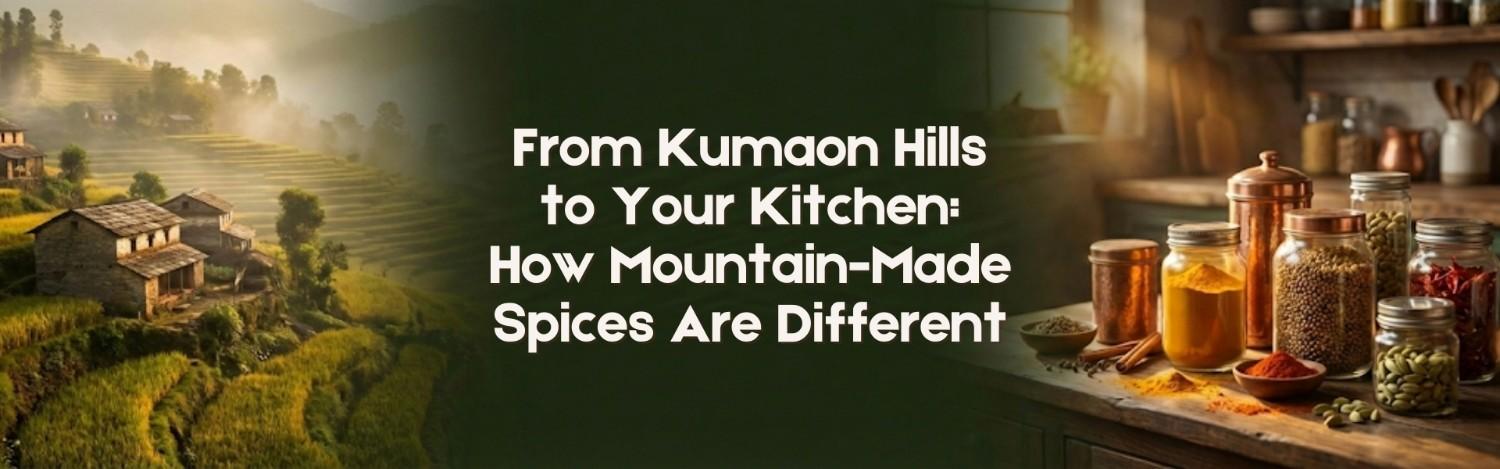
From Kumaon Hills to Your Kitchen: How Mountain-Made Spices Are Different?
In recent times, home cooks and professional chefs have started to switch from mass-produced spices to ingredients with depth, provenance, and authenticity. This shift has increased the popularity of Himalayan and mountain-grown spices, especially from Kumaon in Uttarakhand.
Here’s what makes mountain-made spices so different-
Altitude, climate, soil, biodiversity, and centuries-old farming wisdom. All these factors directly influence aroma, flavor intensity, and nutritional value.
In this blog, we have discussed how spices grown in the Kumaon hills have become popular in every household, beyond mountain farms, and what makes them special.
Why are the Kumaon Hills Ideal for Spice Cultivation?
The Kumaon hills range between 600 and 2500 meters above sea level. They combine:
- Cooler average temperatures,
- Wide temperature variation during the day and night,
- Rain-fed agriculture,
- Mineral-rich mountain soils.
India’s Spices Board and ICAR suggest that such conditions slow down plant growth. This allows spices to develop higher concentrations of essential oils, the compounds that influence aroma and taste.
Hence, spices grown at altitudes often smell stronger, taste sharper, and remain flavorful longer than those cultivated in warmer lowland regions.
What is the Difference between Mountain-Grown and Lowland Spices?
- Altitude Enhances Aroma and Flavor: Plants that grow in higher altitudes experience mild environmental stress, triggering the production of secondary metabolites, such as terpenes, flavonoids, and phenolic compounds. These compounds are responsible for increasing aroma and flavor. Studies on crops, such as chilli, cardamom, and bay leaf, state that the higher the elevation, the higher the essential oil density.
- Slower Growth, More Concentrated Taste: Uniform heat and irrigation in the plains help spices to grow faster. Whereas, in the hills, cool temperatures slow the plant’s lifecycle, leading to denser flavor compounds per gram. Hence, a pinch of mountain chilli or bay leaf delivers more punch than the ones grown in lowlands.
- Richer Biodiversity Creates Unique Varieties: Several indigenous spices and herbs, such as jakhiya (wild mustard-like seeds), gandrayani, and jimbu (Himalayan Allium), are cultivated in Kumaon. These are rarely cultivated commercially and thrive naturally in mountain ecosystems. They are widely used in local cuisine for their unmatchable flavors that you won’t find in industrial spice farming.
- Cleaner Growing Conditions: Since there’s lower pest pressure in the mountains, there’s a minimal requirement for pesticides. Kumaon farms depend on natural compost, traditional crop rotation, and rain-fed irrigation. This helps grow cleaner and more natural spices, closer to organic standards.
- Traditional Harvesting and Drying Methods: Kumaon farmers rely on sun-drying at altitude instead of mechanical drying used in large spice belts. This helps preserve volatile oils and prevents the loss of flavors. The original aroma, color, and potency of the spices are retained due to these slower and traditional methods.
- GI-Tagged and Indigenous Excellence: Almora Lakhori Mirch, a chilli native to Kumaon, is one of the finest examples that holds Geographical Indication (GI) status. It is known for its deep red color, sharp heat, and distinct aroma. This chilli shows how geography and tradition together shape flavor.
Popular Mountain Spices from the Kumaon Region
Health and Nutritional Benefits of Mountain-Grown Spices
It has been seen that spices cultivated in harsher climates often contain:
- Higher antioxidant levels,
- Increased polyphenols, and
- Greater essential oil stability.
Capsaicin (in chillies), flavonoids (in bay leaves), and sulphur compounds (in jimbu) help:
- Improve digestion,
- Enhance metabolism, and
- Have anti-inflammatory properties.
Nutritional research published in food science and agricultural journals has widely supported these benefits.
Economic and Cultural Impact of Mountain Spices
Did you know that, according to studies put forth by the Uttarakhand Department of Agriculture, the state produces over 95,000 metric tonnes of spices annually, cultivated across nearly 14,500 hectares?
Since climate change impacts traditional hill crops, the spices grown are climate-resilient. They offer:
- Higher income per hectare,
- Preservation of indigenous knowledge, and
- Reduced migration from hill villages.
Mountain spices aren’t mere ingredients but a bridge between heritage, sustainability, and modern kitchens.
How to Use Mountain-Made Spices in Everyday Cooking?
- Since mountain spices are more potent, you can rely on smaller quantities.
- Make sure you add them towards the end to preserve aroma.
- For maximum flavor, dry roast the spices lightly before grinding.
- Store your spices in airtight containers, away from heat and sunlight.
Conclusion: Why Mountain-Made Spices Belong in Your Kitchen?
The Kumaon hills offer spices that provide depth, authenticity, and intense flavour concentration due to their altitude. Their flavour and overall profile are impossible to replicate with mass-produced spices.
Choosing mountain-made spices means supporting sustainable farming and fostering your local heritage and time-honoured practices to upgrade your culinary skills.
Explore Zaika’s carefully sourced spice range and bring the true taste of the Himalayas to your kitchen. Visit Zaika on your next trip to Nainital and shop for the best quality mountain-made spices.
FAQs
Are mountain-grown spices stronger than regular spices?
Yes, mountain-grown spices have stronger aroma and flavor, due to slower growth and higher essential oil concentration.
Why are Himalayan spices more expensive?
Since Himalayan spices are cultivated in smaller quantities, harvested traditionally, and grown in challenging terrain, they are more premium.
Are Kumaon spices organic?
Most spices are naturally grown with minimal chemical input, though certification varies by farm and product.
How should mountain spices be stored?
You can store mountain spices in airtight containers, away from moisture and sunlight. They help retain their aroma and potency.
Can I use mountain spices in everyday cooking?
Yes, you can use mountain spices in everyday cooking. However, ensure you use slightly less quantity to avoid overpowering the dish.